
stringbasso (![[personal profile]](https://www.dreamwidth.org/img/silk/identity/user.png) stringbasso) wrote2018-02-09 04:32 pm
stringbasso) wrote2018-02-09 04:32 pm
stringbasso) wrote2018-02-09 04:32 pm


Интересно ....
А на каком языке написано название страны-хозяйки?
Такое написание *Corea* было принято в английском языке, если не ошибаюсь, в 19 веке
УПД. Глянул в вики. Там все сложно
As with other European languages, English historically had a variety of names for Korea. These included "Cauli" (Marco Polo's rendering of Goryeo), Caule, Core, Cory, Caoli, and Corai as well as two spellings that survived into the 19th century, Corea and Korea. The modern spelling, "Korea", first appeared in the late 17th century in the travel writings of the Dutch East India Company's Hendrick Hamel. The terms "Chosunese" or "Chosonese" were first used to refer to the people of Joseon in the late 19th century but were eventually phased out.Despite the coexistence of the spellings "Corea" and "Korea" in 19th-century English publications, Koreans believe that Japan, around the time of the Japanese occupation, intentionally standardised the spelling on "Korea", so that "Japan" would appear first alphabetically. Both major English-speaking governments of the time (i.e. the United States and the United Kingdom and its Empire) used both "Korea" and "Corea" until the early part of the colonial period. English-language publications in the 19th century generally used the spelling Corea, which was also used at the founding of the British embassy in Seoul in 1890.[18] However, the U.S. minister and consul general to Korea, Horace Newton Allen, used "Korea" in his works published on the country. At the official Korean exhibit at the World's Columbian Exhibition in Chicago in 1893 a sign was posted by the Korean Commissioner saying of his country's name that "'Korea' and 'Corea' are both correct, but the former is preferred." This may have had something to do with Allen's influence, as he was heavily involved in the planning and participation of the Korean exhibit at Chicago.
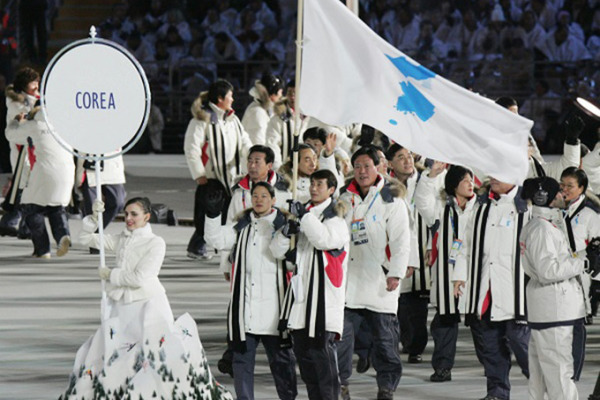
Такое написание *Corea* было принято в английском языке, если не ошибаюсь, в 19 веке
УПД. Глянул в вики. Там все сложно
As with other European languages, English historically had a variety of names for Korea. These included "Cauli" (Marco Polo's rendering of Goryeo), Caule, Core, Cory, Caoli, and Corai as well as two spellings that survived into the 19th century, Corea and Korea. The modern spelling, "Korea", first appeared in the late 17th century in the travel writings of the Dutch East India Company's Hendrick Hamel. The terms "Chosunese" or "Chosonese" were first used to refer to the people of Joseon in the late 19th century but were eventually phased out.Despite the coexistence of the spellings "Corea" and "Korea" in 19th-century English publications, Koreans believe that Japan, around the time of the Japanese occupation, intentionally standardised the spelling on "Korea", so that "Japan" would appear first alphabetically. Both major English-speaking governments of the time (i.e. the United States and the United Kingdom and its Empire) used both "Korea" and "Corea" until the early part of the colonial period. English-language publications in the 19th century generally used the spelling Corea, which was also used at the founding of the British embassy in Seoul in 1890.[18] However, the U.S. minister and consul general to Korea, Horace Newton Allen, used "Korea" in his works published on the country. At the official Korean exhibit at the World's Columbian Exhibition in Chicago in 1893 a sign was posted by the Korean Commissioner saying of his country's name that "'Korea' and 'Corea' are both correct, but the former is preferred." This may have had something to do with Allen's influence, as he was heavily involved in the planning and participation of the Korean exhibit at Chicago.
A shift can also be seen in Korea itself, where postage stamps issued in 1884 used the name "Corean Post" in English, but those from 1885 and thereafter used "Korea" or "Korean Post". By the first two decades of the 20th century, "Korea" began to be seen more frequently than "Corea" – a change that coincided with Japan's consolidation of its grip over the peninsula. Most evidence of a deliberate name change orchestrated by Japanese authorities is circumstantial, including a 1912 memoir by a Japanese colonial official that complained of the Koreans' tendency "to maintain they are an independent country by insisting on using a C to write their country's name." However, the spelling "Corea" was occasionally used even under full colonial rule and both it and "Korea" were largely eschewed in favor of the Japanese-derived "Chosen", which itself was derived from "Joseon".